
Perspektif
What Is a Cold Room? Cold Room Systems and How They Work
September 19, 2026
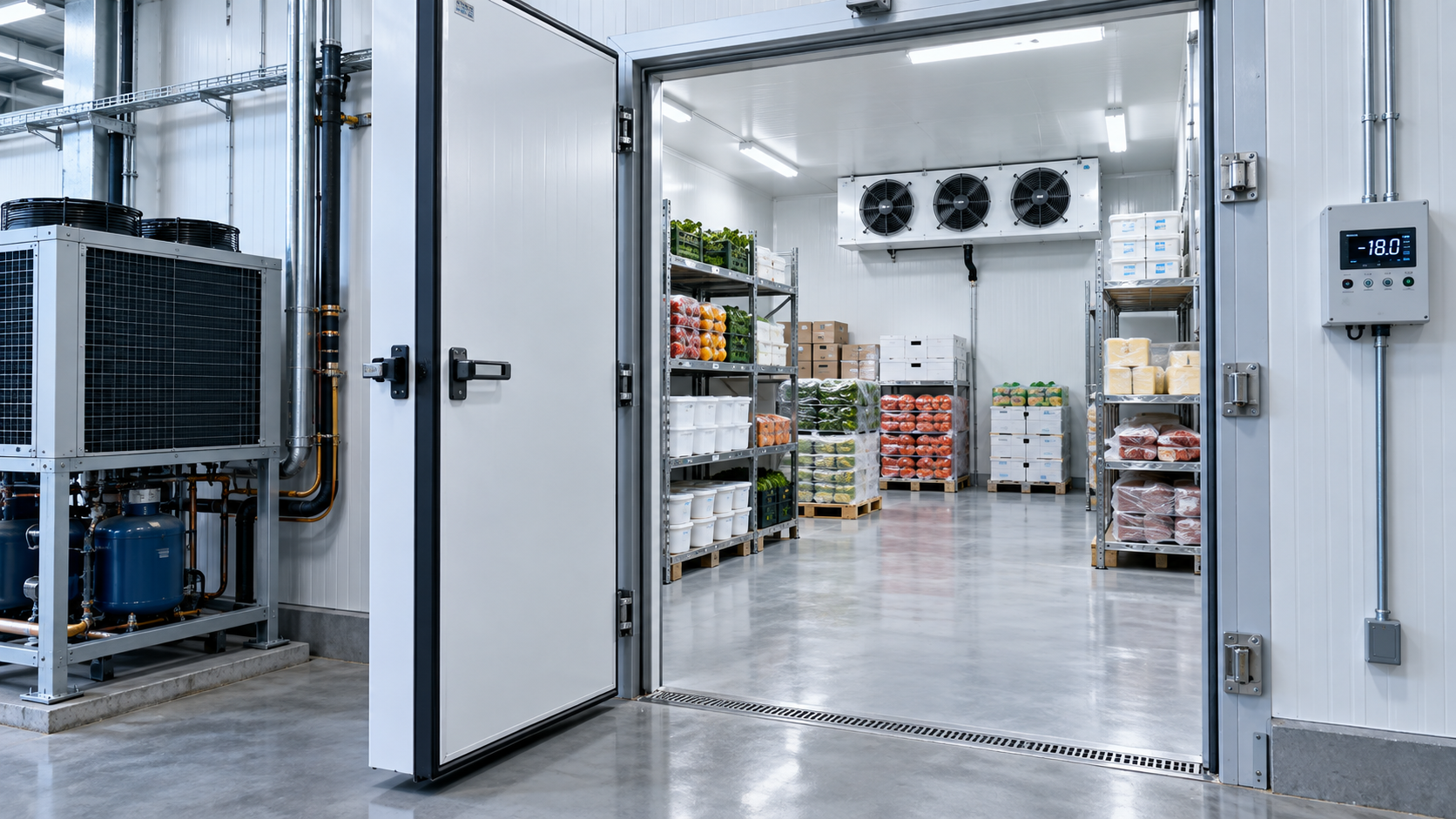
What makes a cold room truly effective is not simply reaching a low temperature, but maintaining the right conditions consistently. Learn how cold room systems work, which components they use, and what should be considered when designing an efficient industrial refrigeration system.
A cold room is much more than an insulated space kept at a low temperature.
In professional refrigeration, the real challenge is not simply cooling a room. It is maintaining the required temperature consistently while products enter and leave, doors open throughout the day and external conditions change.
That is why an efficient cold room must be designed as a complete system.
What Is a Cold Room?
A cold room is an insulated, temperature-controlled storage area used to preserve food, beverages, pharmaceutical products, agricultural goods and other temperature-sensitive products.
Unlike a conventional storage room, its internal temperature is continuously controlled by a refrigeration system.
However, not every product requires the same storage conditions.
Fresh vegetables, dairy products and frozen meat all have different temperature and storage requirements. For this reason, a professional cold room project should not begin with the question:
“How large should the room be?”
The more important question is:
“What product will be stored, at what temperature and under which operating conditions?”
This is where proper cold room design begins.
How Does a Cold Room Work?
A refrigeration system does not actually “create cold”.
Instead, it removes heat from inside the cold room and transfers that heat to the outside environment.
This process takes place through a continuous refrigeration cycle involving several important components.
Compressor
The compressor circulates and compresses the refrigerant within the system.
It is one of the main components responsible for maintaining the refrigeration cycle.
Condenser
The condenser releases the heat collected from inside the cold room into the external environment.
Its location, ventilation and operating conditions can therefore directly affect system performance.
Expansion Device
The expansion device reduces the pressure of the refrigerant before it enters the evaporator.
Although relatively small, it plays an essential role in the refrigeration cycle.
Evaporator
The evaporator absorbs heat from the air inside the cold room.
Fans circulate the cooled air throughout the room while the absorbed heat is carried through the refrigeration system.
In simple terms:
Heat is collected from the cold room → transported through the refrigeration system → released outside → and the cycle begins again.
What Determines Cold Room Performance?
Two cold rooms of exactly the same size may require completely different refrigeration capacities.
Why?
Because room dimensions are only one part of the calculation.
Important factors include:
• Required room temperature • Ambient temperature • Product type • Product entry temperature • Daily product load • Door opening frequency • Insulation quality • Panel thickness • Cold room door type • Evaporator selection • Condensing unit capacity • Operating hours
This is why there is no universal answer to questions such as:
“What refrigeration unit is suitable for a 20 m² cold room?”
The correct refrigeration capacity must be calculated according to the actual operating conditions of the project.
A professional refrigeration project begins with understanding the load, not simply choosing a machine.
Main Components of a Cold Room
An efficient cold room consists of several systems working together.
Cold Room Panels
Insulated panels reduce heat transfer between the cold room and the outside environment.
Poor insulation can increase the refrigeration load, cause longer compressor operating times and increase energy consumption.
For this reason, cold room panels should be considered part of the refrigeration system rather than simply walls.
Cold Room Doors
The door is one of the most active points of a cold room.
Every time it opens, warm and humid external air can enter the controlled environment.
Sliding doors, hinged doors and other industrial door solutions should therefore be selected according to traffic, room dimensions and operational requirements.
Refrigeration Equipment
The compressor, condenser, evaporator, expansion components and control equipment work together to maintain the required conditions.
The objective is not to install the largest possible refrigeration unit.
The objective is to install the correct refrigeration capacity.
An undersized system may struggle to reach the required temperature.
An oversized system does not automatically mean better performance either.
Correct equipment matching is essential.
Positive and Negative Temperature Cold Rooms
Cold rooms can also be classified according to their operating temperature.
Positive Temperature Cold Rooms
Positive temperature rooms are commonly used for products that require refrigeration without freezing.
Applications may include:
• Fresh fruit and vegetables • Dairy products • Beverages • Prepared food • Certain pharmaceutical products
Negative Temperature Cold Rooms
Negative temperature cold rooms operate below 0°C and are commonly used for frozen products.
Typical applications include frozen foods, meat products and long-term frozen storage.
However, refrigeration design should never be based only on whether the room is “positive” or “negative”.
The stored product should always remain at the centre of the design process.
Cold Room vs Cold Storage Facility
The terms cold room and cold storage facility are sometimes used interchangeably.
However, large cold storage facilities may involve a much wider engineering scope.
These projects can include:
• Multiple temperature zones • Loading areas • Industrial doors • Racking systems • Central refrigeration systems • Product flow planning • Monitoring systems • Logistics infrastructure
A restaurant cold room and a large distribution warehouse may use the same basic refrigeration principles, but they should not be designed in the same way.
One of the Most Common Cold Room Mistakes
A common mistake is starting the project by choosing equipment.
Questions such as:
“How many horsepower should the compressor have?”
“Which evaporator should we use?”
“How thick should the panels be?”
are important.
But they should come after the operating requirements have been clearly defined.
Incorrect system design may result in:
• High energy consumption • Long temperature pull-down times • Unstable room temperatures • Excessive compressor operation • Heat loss through doors and insulation • Premature equipment wear
A properly designed cold room treats the room, the product and the refrigeration equipment as one complete system.
A Good Cold Room Does More Than Cool
A successful cold room should not simply display a low number on a temperature controller.
Its purpose is to maintain the conditions required by the stored product reliably and efficiently during real operating conditions.
For this reason, the initial purchase price should never be the only consideration.
Energy consumption, insulation performance, equipment compatibility, service accessibility, operating conditions and long-term efficiency should all be evaluated together.
A system may work on the first day.
The real question is whether it will continue to perform correctly under daily operating conditions.
The CPR Trading Approach
At CPR Trading, we approach cold room systems as integrated refrigeration solutions rather than a simple list of products.
Cold room panels, doors, refrigeration equipment and control systems should be selected according to the requirements of the project and designed to work together.
Because in industrial refrigeration, reliable performance is rarely the result of a single component.
It comes from selecting the right components for the right application.
For cold rooms, cold storage facilities and industrial refrigeration projects, CPR Trading provides equipment and solution options according to project requirements.
CPR Trading
Let our expertise support your project
Contact our team to discuss your technical needs and project-specific solutions.